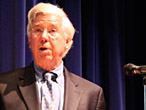
Gov. Glendening challenges Ranson, WV to plan for the future, to protect resources, and to stimulate economic growth through community design

Governor Glendening in Ranson, WV

Last night, President of Smart Growth America’s Leadership Institute and the Governors’ Institute on Community Design, Governor Parris Glendening delivered the keynote address to kickoff a weeklong planning workshop in Ranson, WV (crossposted from Smart Growth America).

Together with EPA Assistant Administrator Mathy Stanislaus, Governor Glendening provided context at the opening session. Governor Glendening addressed how the Ranson community can meet changing demographic trends, protect natural resources, and overcome current economic challenges through planning dense, walkable, livable areas connected to housing and transportation. More information on the opening session here.

In the weeklong ‘mega’ planning workshop (September 8-14), the Ranson community will discuss issues and ideas before draft plans are completed for each of four, linked and interdependent projects that are being funded by the Partnership for Sustainable Communities. Ranson is one of only two communities that was awarded grants by all three partner agencies for a combined total of $1.4 million in planning grants (the other community is Denver, CO). Read more about the weeklong workshop and the four projects at Ranson Renewed.

Since the Partnership for Sustainable Communities was created in 2009, the Governors’ Institute on Community Design has supported the Partnership’s efforts to improve access to affordable housing, more transportation options, and lower transportation costs while protecting the environment in communities. The Governors’ Institute has served as a liaison between the Partnership and state administrations, hosting meetings to allow for a dialogue between federal and state officials. To learn more about the partnership agencies, see Partnership for Sustainable Communities.

National experts advise the Christie Administration on state strategic planning

Crossposted from Smart Growth America’s coalition partner, New Jersey Future.

The Governors' Institute hosted a workshop in Trenton, New Jersey for the state cabinet members on May 18th and 19th.

Last week, the Christie administration hosted a Governors’ Institute on Community Design workshop to explore advancing a state strategic plan that focuses on economic development and the importance of location. The event was a milestone in the administration’s state strategic planning project, which is developing recommendations for how to prioritize and support sustainable economic growth.

Lieutenant Governor Kim Guadagno along with cabinet members and other state officials attended the day-and-a-half long workshop. Visiting speakers included Doug Foy, President, Serrafix and former secretary of Commonwealth Development in Massachusetts; Mitch Silver, Director of Planning and Economic Development for Raleigh, North Carolina; and Daniel Hernandez, Managing Director of the Planning Practice at Jonathan Rose Companies. Kicking off the event were GICD Chair and former Maryland Governor Glendening and former New Jersey Governor and GICD co-chair Christine Todd Whitman.

“Governor Christie was pleased to host the Governor’s Institute on Community Design, “said Wayne Hasenbalg, Deputy Chief of Staff for Policy for the Christie Administration. “This Administration is taking a thoughtful approach to economic development that includes looking at the most efficient places to direct growth.”

The administration is expected to finalize recommendations to the Governor in July. For more information about these and other workshops, visit the Governors’ Institute on Community Design.

A new director and new approach at the Governors’ Institute on Community Design

Jody Tableporter, Director, Governors' Institute on Community Design (Image Credit: Harvard University)

For the past six years, NEA has partnered with the Environmental Protection Agency to sponsor the Governors’ Institute on Community Design. The Governors’ Institute conducts state-level work on design, sustainability, and placemaking to foster connected, economically vital communities that tread lightly on the environment.

Jody Tableporter, the new Director of the Governors’ Institute, had this to say as she took up her new role:


NEA: It is a great job, but a challenging one. Are you up for the challenge?

Jody Tableporter: I love the complexity and challenge of working across policy, projects, and place. It probably helps that I’ve been in the middle of delivering complex projects like the expansion of the Tate Modern – things don’t get much messier than that!


NEA: What do you hope to accomplish while you’re at the Governors’ Institute?

JT: I’d like to blend the best of design, economic development, and city building to help states help communities. This means bringing the best experts and proven practice to the toughest problems, as well as piloting new solutions.


NEA: What do you hope to learn while you’re at the Governors’ Institute?

JT: Despite having a job that is focused, analytical, and “big picture” by nature, I love experiencing what is unique and extraordinary in communities, whether it be a locally grown arts organization or amazing architecture. I will be soaking up as much as possible on my trips to meet with governors and state administrators.


NEA: What experience from past jobs will you put to use in your new role?

JT: I worked in industry strategy and real estate development before combining that experience in city and regional placemaking. I have been on architecture design teams and I have worked with engineers on infrastructure delivery, with businesses and industry clusters, and as a public funder of major projects and programs.


NEA: What are you most proud of accomplishing during your career to date?

JT: Creating a plan for South London that supported arts organizations as part of an economic strategy. Many questioned whether the Tate, South Bank Centre, and the Young Vic Theatre, all established London arts institutions, needed more government funding. I never did. They have had a tremendous impact on the local economy, as well as London’s place in the world.


NEA: Given the types of programs and projects you’ve overseen throughout your career, how would you define “Creative Placemaking?”

JT: Using creative design to plan and coordinate physical projects, e.g., transit corridors; capitalizing on local arts organizations and clusters to anchor the economics and heart of communities. After all, creative placemaking is about creating great places that foster entrepreneurs and cultural industries that generate jobs and attract businesses.


NEA: We’ve been talking a lot about the relationship between creative industry and the economy. What do you think is the link?

JT: Creative industry is a local economic driver; it is one of those vital economic “clusters” that is almost universal.


NEA: Tell us one of your guilty pleasures?

JT: Snuggling down with my family to watch old musicals; it is what I did with my family growing up.


NEA: Any last words?

JT: Can’t wait to get going!