If that road feels out of place, that’s probably because it is

State DOTs often use guidance and a project selection process that leads to overbuilt projects that don’t fit their context and are ill tailored to the needs of the community. To build better projects that fit in the areas they serve, state DOTs need to acknowledge land use and context and update their project selection process to focus on outcomes.

This is the fifth post in a short series about states that are finding success through what’s known as practical solutions, a way for transportation departments to meet changing demands and plan, design, construct, operate, and maintain context-sensitive transportation networks that work for all modes of travel. Read the first, second, third, and fourth posts.

We’ve all seen roads that are very out of place: a four-lane, one-way “boulevard” that cars race along in a residential area. Or that road with eight wide lanes that cuts through a commercial district where sidewalks (if they exist) are constantly interrupted by driveways.

Roads like this don’t happen by accident. They are often the end product of a design/construction process that ignores the land use or context around them. And they’re chosen for funding based on a selection process that is opaque and doesn’t relate to the overarching goals of the agency, be they economic, environmental, equity, or safety goals.

As we’ve noted throughout this series, state DOTs spent years razing whole neighborhoods to construct highways through rural areas, older suburbs, and city centers, often with the same exact design through all three areas that have wildly different needs. And many of those practices have failed to evolve. Aligning project selection with agency goals and accounting for the local context (rural, suburban, urban) in project design are the final major components of a practical solutions framework.

How to address land use and context
Land use and transportation are inextricably linked, but state DOTs often do not have control over land use decisions—nor should they. But a lack of control over land use isn’t a good reason to ignore it; it’s critical that transportation investments are coordinated with the local land use to ensure that projects match their context and need.

One common way to do this is to create context classifications—such as rural, small town, suburban, urban, and urban core—to spell out appropriate parameters for design. Taking it a step further, such classifications should be reflected in the state design manuals or guidance. Without these steps, roads often end up resembling highways regardless of their context.

Image: FDOT Context Classifications.

States can also use their funding decisions to create a positive feedback loop ensuring transportation investments and local land use decisions are aiming for the same goals. They can prioritize and fund projects in communities where the locality is working as a partner; for example, localities that prioritize compact, walkable development and use transportation demand management (TDM) strategies to reduce future travel demand should be rewarded for saving the state money by avoiding the need to expand roads or build other new infrastructure entirely. States should also evaluate whether their own proposed investments match the local context. Projects that are harmonized with local land use should be prioritized for funding and those that are not should be postponed or sent back to the drawing board.

States can also help localities—particularly those with limited resources—understand how local regulations like hefty parking requirements or single-use zoning that separates jobs from housing can affect transportation demand and the impacts on the local street network.

Prioritizing projects based on outcomes
Most states have an opaque or hard to understand process for picking which projects get funding. And even if a state thinks their process is clear, the public at large most certainly does not, believing that most processes are entirely about political influence, not merit.

Some DOTs are turning to a well defined project scoring process that objectively evaluates projects based on expected outcomes that relate to the agency’s goals. Whether it’s safety, access to jobs, economic development, or any other goals, here are some strategies to orient project selection based on outcomes:

  • Don’t segregate modes—having a process that prioritizes (and funds) projects regardless of mode of travel can allow for more cost-effective solutions.
  • Use long-range plans to set the goals that determine project selection—actually using stated goals to drive selection will increase accountability and trust with the community.
  • Develop a numerical scoring system—identify performance measures to evaluate all projects consistently and give them a score based on the sum of how well they perform in each policy category.
  • Measure outcomes instead of just current conditions—measuring how well a project will address the stated need is different than measuring how big the magnitude of the current problem is.
  • Consider costs, not just benefits—without considering cost in rankings, the process will naturally bias larger, more expensive projects.
    Pilot your approach—this is an art, not a science, and piloting allows you to work out kinks in the scoring process.
  • Conduct outreach to build buy-in for the new process.
  • Update project selection criteria regularly—updates should reflect new long-range plans, new methodologies, or correct for unintended outcomes.

Changing DOT practices isn’t easy; it’s like rerouting a river that’s carved a deep canyon over multiple decades. But as states are confronted with limited funds, degraded infrastructure, and existential threats from climate change, there may be little other choice. If states pursue a practical solutions approach as outlined above and in the previous posts they can set themselves on a track to produce more affordable projects that will better meet the needs of the communities they serve.

For more information about practical solutions, see all the in-depth memos.

“Incorrect assumptions lie at the root of every failure.”

State DOTs founded to build highways are now in charge of building and operating a much broader array of transportation infrastructure and services than ever before. But to build more cost-effective projects that meet modern mobility challenges and broader economic and environmental goals, state agencies will have to reassess the assumptions that so often drive them in the wrong directions.

This is the fourth post in a short series about states that are finding success through what’s known as practical solutions, a way for transportation departments to meet changing demands and plan, design, construct, operate, and maintain context-sensitive transportation networks that work for all modes of travel. Read the first, second, and third posts.

As we covered in the previous post, to better consider all of the users of the transportation system, state DOTs need to update the embedded culture, practices and processes that affect projects long before a shovel is ever put in the ground. But making these upstream changes will only get you so far and the assumptions used during project design and project selection are a major obstacle to change.

As Brian Tracy famously said, “incorrect assumptions lie at the root of every failure.” And they have to be brought to the surface and addressed head-on. First is the biggest assumption of them all: That the basis of most roadway design, level-of-service, is an adequate measure of transportation performance.

Reevaluating level-of-service
Level-of-service (LOS) has been the dominant performance measure for roadway design, and continues to drive transportation agencies toward overbuilt, expensive, car-oriented highways and sprawling development. It’s a blunt measure of traffic delay that assigns a letter grade based on the number of seconds vehicles (and only vehicles, not people) have to wait to go through a corridor or an intersection during a particular hour. An ‘A’ grade means free flowing traffic , an ‘F’ means a forced or breakdown in traffic flow. DOTs will never be able to shift practices away from over-designing roadways unless they take steps to change expectations around LOS. Quite simply, LOS is the elephant in the room.

There are three main options to deal with this elephant.

First, state DOTs can relax their commitment to using LOS. It may often be okay to accept some vehicle delay, especially if that fits with community goals for a walkable corridor or in an instance where LOS is only degraded for a short period of time each day (like evening rush hour) but is otherwise acceptable.

The second option would be to adjust the weight of LOS relative to other measures like safety or accessibility to paint a more accurate picture of the need for projects beyond “always move the cars fast.” LOS often gets the most weight and as a result is really the only factor that matters.

The final option, and the most ambitious one, is to replace LOS with a different measure altogether and flip the existing paradigm on its head. Instead of measuring the delay cars experience (regardless of journey length or overall time), using vehicle miles traveled (VMT) instead measures how far people are traveling. States can then set goals to reduce driving in order to improve air quality or address inequities in the transportation system. In California, state law (SB 743) has required state agencies and municipalities to stop using LOS in an effort to reduce greenhouse gas emissions; VMT has been the prevailing replacement. You can read more in detail about this from T4America.

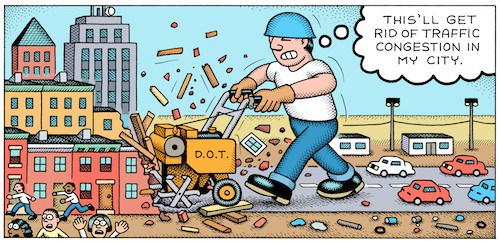
A guy rototills congestion by destroying the city the road is supposed to serveA guy rototills congestion by destroying the city the road is supposed to serveLOS is a relic of the 1960s when we were setting standards for a new national highway system. It makes sense for limited access highways. However, it is now applied rather thoughtlessly to all roads, even neighborhood roads, where the priority is not (or should not be) free-flowing, high-speed vehicle travel. The priority instead may be quality of life or walkability or safety.
Assuming that LOS is an effective measure for the entire transportation system is just one of many assumption state DOTs need to reevaluate.

Addressing assumptions and expanding flexibility
To anticipate future needs, DOTs typically attempt to forecast the future and anticipate what might be necessary in 20 years, often resulting in large, expensive projects that are not yet necessary—and may never be. And excess road capacity is known to induce more demand, creating a vicious cycle. While the intention is noble, it is impossible to forecast traffic conditions 20 years out and existing models assume traffic growth is inevitable (an outdated assumption in and of itself).

Other assumptions are based on the perceived need to build to the “highest level” of road design, design that is largely based on highways built in rural settings: straight, wide lanes and spacious shoulders. This kind of design is rarely appropriate beyond rural settings or limited access highways, yet state DOTs still build roads as if it were. Instead, cost-effective design that supports local economic activity and all kinds of travelers should be encouraged.

However, such designs often require a “design exception” or “waiver” because they deviate from the established highway-style design standards. Including commonly requested design exceptions into the DOT standards themselves is one way to encourage their application. Changes in terminology to avoid terms like “exceptions” or “waivers” that imply that something is amiss or unusual can help too. States can also make the process easier or less intimidating by offering guidance on common circumstances where “appropriate design” might be warranted and what justification might be needed.

And finally, the model that states use to determine the level of traffic roads should be built to accommodate (known as the 4-step model) is a blunt tool that should be reassessed. Among its flaws, it doesn’t capture shorter trips, so it leaves out bicyclists and pedestrians. It also contains a lot of baked-in assumptions—like consistent, high growth in population and overall travel, and that most (if not all) trips will be in a car—that are often wrong and fail to take into account changing development or personal preferences that affect where people live and travel to.

In other words, this model will assume you are going to drive four blocks from work to lunch, whether you are in a sprawling area that is dangerous for pedestrians or a busy, easily walkable downtown where parking is in short supply and restaurants are all around. This blunt model is what we use as the basis for designing hundreds of billions of dollars of projects each year. For a more in-depth look at the 4-step model and potential fixes, see the memo.

Many of these decades-old assumptions were designed specifically for highways but have been applied to all roads, and haven’t been updated to reflect the new responsibilities DOTs have or the new challenges states face today. As we’ll explain in our next post, updating or eliminating these assumptions in agency work can help pave the way to projects that better reflect their context and community needs.

Read the fifth post in this series: If that road feels out of place, that’s probably because it is >>

Building a better transportation system starts long before breaking ground

State DOTs were largely created to build highways, but they are now responsible for moving people and goods safely and efficiently across multiple modes—bike, walk, bus, trains, ferries, and cars. To do a better job of meeting all these diverse needs and provide a multimodal transportation system that supports economic growth and livable communities, changes to their policies, internal processes, and agency culture are required.

This is the third post in a short series about states that are finding success through what’s known as practical solutions, a way for transportation departments to meet changing demands and plan, design, construct, operate, and maintain context-sensitive transportation networks that work for all modes of travel. Read the first and second posts. Read the fourth post here.

Although state DOTs that were largely created to build roads have changed to reflect a modern mission to address transportation holistically, it’s hard to break out of the decade-old ruts that have led them to the continued construction of more highways and highway-like streets that are often dangerously out of place within many communities.

To better achieve their broad missions and get more bang for their buck, state DOTs need a major update to their thinking, planning & design for projects, funding, decision-making frameworks, and the metrics they use to measure success: what we call “practical solutions.” But the most crucial steps for implementing this approach happen long before funding is allocated and certainly long before a shovel ever hits the ground, in upstream areas like addressing agency culture and administration, project scoping, and public engagement. These areas may sound dry and boring but have an outsize impact on what gets built and where, how much it costs, and whether or not it helps accomplish a state’s goals.

Over the past two years, we worked with nine states—Delaware, Iowa, Louisiana, Maine, New Hampshire, North Dakota, Pennsylvania, Tennessee, and Virginia—to help them better align their practices with their aspirations. Through this work we identified seven general areas that, if changed, would allow DOTs to better serve their state’s modern day needs and reach their goals. Below is a look at three of those seven area. We’ll cover the other four in two more posts to come.

Culture & administration
The first thing a new recruit at a state DOT will experience is the culture. How committed are the bosses and managers to developing a multimodal transportation system? How will their job performance be evaluated? What kind of training and support is in place?

Changing the culture of an agency has to start at the top with headquarters, district leadership, and project managers all singing from the same song sheet. A statement like “Staff are encouraged to utilize their own informed engineering judgment and innovative multimodal roadway treatments tailored to the specific context and needs of the community” (rather than just leaning unquestioningly on off-the-shelf “standard” design), sounds a lot different than, “bring projects in on-time and under-budget.”

Statements alone won’t change practice though. Following through and evaluating performance of staff based on those principles is key: how well do projects balance the needs of different users, how and when was the public engaged, do projects advance agency goals, etc.?

Ongoing training is critical for success. Saying all the right things and changing performance reviews won’t help much without training staff on how to do what is being asked of them. Staff will flounder without the appropriate training, much as state DOTs have as their mandates extended beyond building highways but their training and expertise never adjusted accordingly. And that training can’t just focus on design—it should start at the very beginning of a project with scoping.

Getting project scopes right
One of the biggest barriers to practical solutions is the practice of defining the need for a project as a specific improvement (ex. add a turn lane) instead of a problem to be solved (i.e. northbound backups at Second and Main during the afternoon rush). And when a Purpose and Need statement goes so far as to include a specific approach (add the turn lane), then all other features—sidewalks, crosswalks, pedestrian refuge islands, or bicycle facilities—become “add-ons” or “amenities” which are first to get scrapped when confronted with funding constraints. Starting with a clear definition of the problem rather than a specific improvement can make such “amenities” central components of a future project and open the door to more inexpensive solutions (like retiming traffic lights).

For example, upon reviewing one specific project scope to better define the problem at hand, the Tennessee DOT found that safety improvements like curve warnings, school speed limit signs, stop signs, and other pavements and signage improvements could be made for $85,000 instead of the $58 million road widening that was originally proposed, and achieve many of the same benefits.

Doing thorough legwork to really dig into the need behind a project during scoping takes more time and resources. But taking the time to get the scope right results in projects that are better calibrated to solve the actual problems at hand. Plus, the state can better coordinate with local partners (and the public) about the priorities for a corridor (such as emphasizing regional throughput versus local travel and economic development) which could impact the solution that’s chosen.

Doing more of this engagement upfront often reduces delays later in the process caused by local concerns, even for repair projects, where more coordination with local agencies during scoping can reduce costs for both (for example, by timing a local utility project with a roadway resurfacing project to avoid tearing up the road twice). Similarly, a better scoping process can allow states to revisit projects that have been in the funding queue for a long time to clarify the current need, potentially reducing the scale and cost of projects to finally get them funded.

Changing the way staff are evaluated (as mentioned in the previous section), providing guidance on what questions need to be answered with a scope, building multidisciplinary project teams, and requiring those teams to physically visit and navigate the area on foot or bike can all help create more effective scopes.

Improving public engagement
While state DOT leadership and staff generally understand the importance of robust community engagement, in practice, such engagement happens infrequently; it’s expensive and time consuming under current procedures that don’t recognize its value. Real community engagement requires project teams to accept that they may have to let go of their preferred solution for something that better reflects community needs but still meets the carefully crafted Purpose and Need statement (see above).

But it’s also about meeting people where they are, with the right messengers, and setting clear expectations. Are you expecting people to come out to a special meeting in the middle of a workday to hear from a DOT staffer who is just going to tell them about a project that’s already been developed? Or, is it possible to meet people at an existing community event with a local leader and ask for input? Is it clear if feedback will be driving the design process, are only small changes possible at this point, or is the engagement simply to convey information?

In a practical solutions approach, public engagement, agency culture, and project scoping all feed off of each other. Better community engagement can lead to more appropriate scopes that drive better performance at an agency that values engagement. Ongoing training can prepare staff to create scopes that define a problem instead of a project which can be used to facilitate deeper engagement with the community about their needs.

For examples and more information on each of these components of practical solutions, including information on states that are implementing some of these recommendations, read the full memos on practical solutions that were prepared for this project. We’ll be later this week and next to continue discussing the other areas of practice where state DOTs can update their practice for the modern era.

Read the fourth post in this series: “Incorrect assumptions lie at the root of every failure.” >>

How a singular focus on speed leads state DOTs to overspend and overbuild

The most productive state departments of transportation are those that have come to grips with the fact that moving cars fast all the time is hard to square with most of their other stated priorities, whether improved safety, more mobility, or reduced costs.

Over the last two years, The Governors’ Institute on Community Design has been working to help a small group of state departments of transportation question and assess the underlying assumptions that result in giant highway solutions for every transportation problem. This is the second in a series about the states that are finding success through what’s known as practical solutions, a way for transportation departments to meet changing demands and plan, design, construct, operate, and maintain context-sensitive transportation networks that work for all modes of travel. Read the third post here.

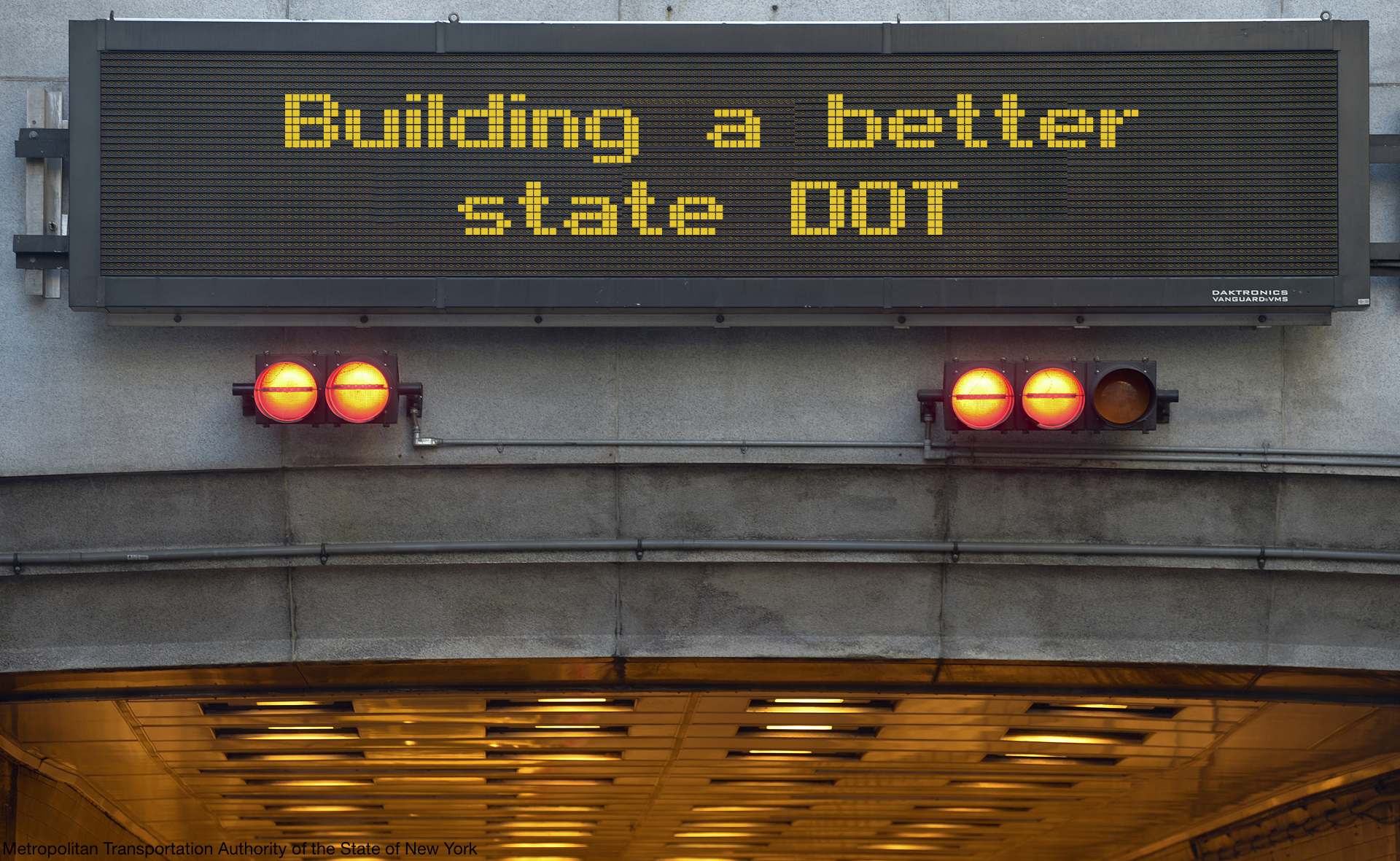
a variable traffic message board above a tunnel that reads Building a better state DOT
An example of two streets managed by a state DOT, with drastically different purposes. Does your state know how to treat them differently?

In our first post, we showed how state departments of transportation (DOTs)—with highway-building DNA embedded deep within them—are now tasked with building and/or operating transit, building streets to serve a wide range of mobility needs, moving people instead of just vehicles, to name just a few. And then they are asked to balance this new diverse portfolio against a single stated (explicit or implicit) priority of building roads on which cars can always travel as fast as possible.

As we chronicled, even in states that want to find a new way of doing business, most struggle against decades of embedded culture and practice that was designed to create the Interstate system and move vehicles quickly through communities. Some are being given what could best be described as an impossible task: help connect people to places worth visiting, and then make certain they never have to slow down once they get there, making it not that enjoyable to visit.

What are some of the biggest struggles for state practitioners, and what have we seen in our two years of work with a handful of them? Here are four things we frequently hear:

It’s nearly impossible to square the priority of speed with most other state goals
It’s hard to surface the assumptions that are rooted deep in the DNA of a state DOT. And their assumed number one priority is so built-in from decades of practice that it’s rarely stated out loud. This assumption of “the cars need to always move fast and never slow down” is at the root of most of the big problems that they face. Engineers have a prerequisite—sometimes explicitly stated but always implicit in the agency’s culture of practice—that makes every other priority a nearly impossible task.

Make sure the vehicles can always go fast

AND

  • Prioritize repair first
  • Keep everyone safe, including people walking & biking
  • Create vibrant places worth visiting
  • Keep your costs low
  • Don’t negatively impact nearby communities
  • Help connect everyone to jobs and opportunity, whether they drive or not
  • Promote sustainable and lasting economic development
  • Reduce transportation-related emissions

In practice, what this turns into is a list of secondary goals states would like to accomplish, that usually get sacrificed for the real top priority of speed. Until we come to grips with the fact that moving cars fast at all times of day without delay is a goal that can’t always be squared with all of the other priorities, until we can admit that perhaps everyone is not going to be able to go fast all the time, we’ll continue building unnecessarily large and expensive roads where speed is the number one priority and most other priorities fall by the wayside.

States expend a lot of effort trying to squeeze square pegs into round holes, rather than using round pegs
When faced with the challenge of connecting people to jobs and efficiently moving goods and people around, the starting point is usually a high-capacity road or highway. It’s the logical output of state DOTs created to build the autobahn in the US, that got so good at building this one product that they now try to build it everywhere. They take this product and use it as the template to build roads that go through neighborhoods, by schools and are supposed to serve as main streets. The states currently finding a better way forward are opening up their arsenal of solutions to be far more diverse.

State DOTs are reluctant to believe that they can or should dictate behavior
When talk turns to trying to design streets to be safer (which often requires slower speeds), I’ve had traffic engineers express discomfort with using roadway design to dictate to people how they should behave. In fact, they are already making a million design decisions that affect how we behave behind the wheel—including setting speed limits. States design roads to indicate to drivers that they should go fast (with wide, straight lanes and infrequent signals or crossings), and then are surprised when drivers respond logically to that design, acting as if there is nothing they can do to change that or slow them down.

A singular focus on reducing delay leads state DOTs to overbuild roads, waste money, and generate more traffic, as well as many other frequent problems
Design decisions are too often dominated by the worry that traffic level-of-service (delay) might be bad for even short periods of time, and so streets get overbuilt.

Constant free-flowing traffic 24/7 is perpetually held up as the ideal, and we invest accordingly, but we’d never make fiscal decisions like this with our own money. Say you have a big party at your house a few times a year with 50-75 people. Would you pay to renovate the house you live in to add six more bathrooms to ensure that no one has to wait to use the restroom at your party? Or would you rationally expect a bit of waiting? The states going broke (or begging for more money) are the ones that spend millions trying to address a few minutes of excessive delay that happen at limited times.

We always believe the roadways will get more demand, and then it becomes a self-fulfilling prophecy when we overbuild them. That overbuilt road cuts off shorter trips and makes walking and biking dangerous, and then we’re surprised when it generates traffic. The states making the most of their money these days are the ones targeting their investments to the places where traffic truly is bad for the longest period of time, as opposed to trying to avoid any slow down whatsoever.

Even better yet would be agreeing that, sometimes, slower moving traffic is the goal, because it makes the road safer and the surrounding place or neighborhood a better place to be.

Up next, we’ll be looking specifically at some of the recurring lessons we learned over the last two years as we worked with these handful of states to find more flexible ways to solve their problems.

Read the third post of this series: Building a better transportation system starts long before breaking ground>>

Don’t hate the state (DOT): They’re just solving the wrong problem

Over the last two years, The Governors’ Institute on Community Design has been working to help a small group of state departments of transportation question and assess the underlying assumptions that lead many states toward giant highway solutions for every transportation problem.

This post is the first of a short series about states that are finding success through what’s known as practical solutions, a way for transportation departments to meet changing demands and plan, design, construct, operate, and maintain context-sensitive transportation networks that work for all modes of travel. Read the second post here.

a variable traffic message board above a tunnel that reads Building a better state DOT

Most state departments of transportation were created largely for one reason: to implement a highway-building program.

And that’s just what they did for many decades, with sometimes ruthless efficiency, building ever wider and more complicated roadways with funding streams that were increasing year over year as we drove more and the gas tax brought in more money each year. And while advocates certainly raised their voices in objection, the highway-building machine chugged along—as long the money kept pouring in.

Then something started happening in the early 2000’s: Those revenues started flagging because driving declined in a significant way (despite projections by the feds and states that driving would continue on the same impossible upward trajectory into infinity), and the fleet of vehicles became far more fuel efficient.

All of a sudden state DOTs had a fiscal imperative to do more with less and find ways to be more efficient. This was combined with demographic shifts and consumer preferences spurring a move back into downtowns of all sizes, the explosion of growth in new or expanded transit systems, and the rise in the popular consciousness of improving walkability.

And then many states hit a wall.

Why? Because these organizations with highway-building DNA embedded deep in their culture were now being asked to do far more than they once did: Build and/or operate transit, make multimodal connections, focus on moving people instead of just vehicles, make walking and biking safer options, and build things that results in fewer emissions, to name a few.

Or put more bluntly, the same department that delivered this highway below on the left a few decades ago is the same one tasked with delivering the street on the right, perhaps right in front of your house.

So why bother with the state DOT?
The simple answer is that they are still in charge of spending the bulk of the dollars that get invested in transportation, and that’s not likely to change soon. Though some believe that working to influence state DOT spending is like rearranging the deck chairs on the Titanic, until some new system comes to replace them, state DOTs will continue to make the bulk of the decisions about our transportation dollars.

GICD is not willing to let the perfect be the enemy of the much better. We’re far too pragmatic and know that real long-term change is often achieved incrementally.

On top of that, in our work with states across the country, we’ve found that many states are actually eager for a better way of doing business. Some states are frustrated by institutional inertia, by long-since-approved Complete Streets policies that aren’t yet producing safer streets, by once-small projects that somehow mutate and grow unnecessarily in scope and cost, by decades-old plans for unbuilt highways that still continue to hover like ghosts over every conversation about what to build and where.

Numerous governors have also been coming into office having made promises about focusing on mobility and moving people first and foremost, only to discover after inauguration that their “transportation” agency is in fact just a highway agency that’s poorly suited to fulfilling their pledges to the public. They’re making goals but they lack the tools to deliver them.

We have found states that are eager to figure out a better way and find innovative and flexible ways to meet users’ needs that cost less to build and maintain. And over the last two years, we’ve worked to help them identify barriers and find solutions. These are the states to keep your eye on, they’re going to figure it out first.

Over the next few weeks, we’re going to explain how it’s possible for a tiger to change its stripes, how some are leading the way, and the regular obstacles that keep cropping up and need to change.

Let’s build a better state DOT.

Read the second post of this series: How a singular focus on speed leads state DOTs to overspend and overbuild >>

Six state DOTS selected to receive hands-on assistance

We are proud to announce that six state departments of transportation will receive free technical assistance designed to develop flexible ways to meet their users’ needs with practical solutions that cost less to design, build and maintain.

State departments of transportation face increased demands on both their networks and their budgets. Our Accelerating Practical Solutions Program will work with six competitively selected states to help them make investments in transportation that put people first and don’t break the bank:

  • Delaware
  • Iowa
  • Louisiana
  • New Hampshire
  • North Dakota
  • Virginia

Congratulations to these six states. Learn more about what the states we’ll be working with hope to achieve:

Iowa is committed to providing a transportation system that gets you there safely, efficiently and conveniently. We believe the principles taught in the Smart Growth America’s Accelerating Practical Solutions workshop will help us better utilize flexibility and innovation to achieve that goal.”

“The Louisiana Department of Transportation and Development looks forward to finding additional ways to work with other federal, state, and local government agencies and engage the public to come up with transportation solutions that enhance communities and serve all users of the transportation system,” said Dr. Eric Kalivoda, Deputy Secretary of LADOTD.

“The workshop will be especially timely as the New Hampshire Department of Transportation develops new pedestrian and bicycle design criteria that considers safety and access for all modes of travel. The department extends a warm welcome to the Governors’ Institute on Community Design.”

North Dakota seeks to enhance integrated decisions about transportation and land use that meet the needs of all roadway users, and support healthy, vibrant, and economically strong communities.”

“We are honored to be selected for Smart Growth America’s Accelerating Practical Solutions workshop and look forward to learning how to expand and improve Virginia‘s efforts to plan and deliver efficient and affordable solutions to transportation challenges throughout the state.”

Technical assistance will also be awarded to the Delaware Department of Transportation as they work with the University of Delaware on improving access for people of all abilities.

Our expert staff will bring together DOT staff with MPOs, consultants, local governments, advocacy groups, transit agencies, and others for a technical assistance workshop in each state. We’ll explore a range of topics, such as balancing the needs of all roadway users in a variety of contexts, how to take advantage of existing flexibility in design, integrating transportation and land use decision-making, right-sizing projects, and how to make the organizational and cultural changes required to implement practical design.

Interested in this bringing this work to your state? Contact us to learn more about bringing a Practical Solutions workshop to your community >>

Resilience in the U.S. Virgin Islands

usvi-gicd

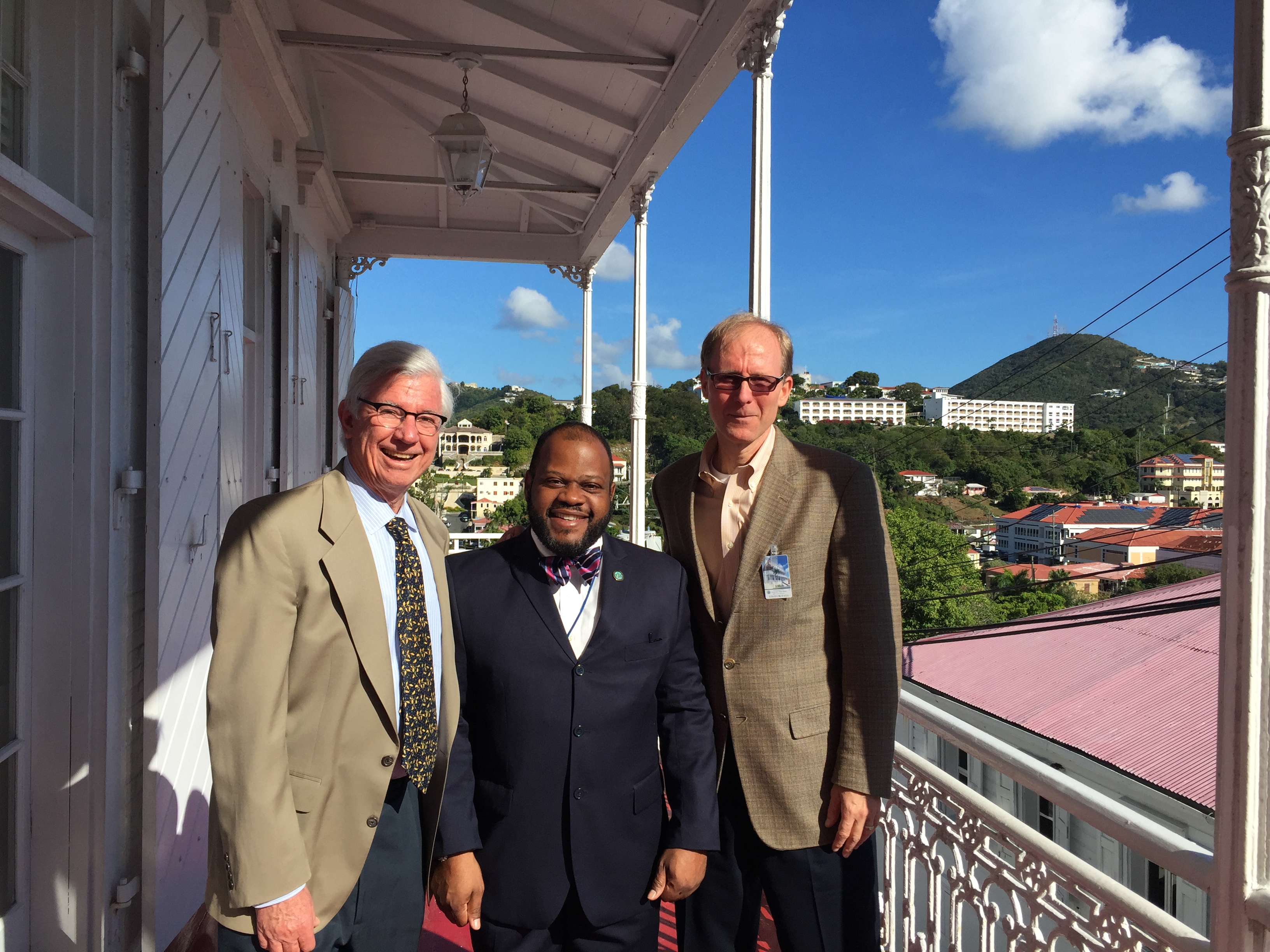
Our team was in the U.S. Virgin Islands last week to help the territory plan for resilience. “Overall, the workshop generated several powerful new ideas and identified a number of short-term solutions that the Climate Change Council can take action on immediately,” said Shawn-Michael Malone, Climate Change Council Chairman.

Over the course of the workshop, participants heard presentations on how to make the Virgin Islands more resilient in the face of hazards associated with climate change, including erosion, hurricanes and rising sea levels. At the same time, members of the Council educated the GICD team on the unique issues facing the Virgin Islands and on our community’s priorities.

On the first day, discussions focused on sharing that critical information and exploring different strategies for reducing risk and building long-term resilience. The second day began with a review of issues raised by the group, and continued with a presentation of possible recommendations for the Virgin Islands and a discussion of how the Climate Change Council could put them into action.

Recommendations included:

  • Developing a “resilience vision” for the Virgin Islands.
  • Altering the hazard mitigation planning process to include climate change strategies, proactive land management, scenario planning, and incorporating adaptation.
  • Educating the public on the hazards of extreme weather and climate change through local schools and universities, youth programs, and existing health and wellness programs.
  • Expanding the disaster recovery process to include climate change planning, while ensuring that citizens are not overburdened by new codes and standards.

The GICD team thanks Governor Mapp and his administration for their ongoing commitment to the protection of life and property in the U.S. Virgin Islands.

Massachusetts announces a “common vision” for housing, transportation, and the environment

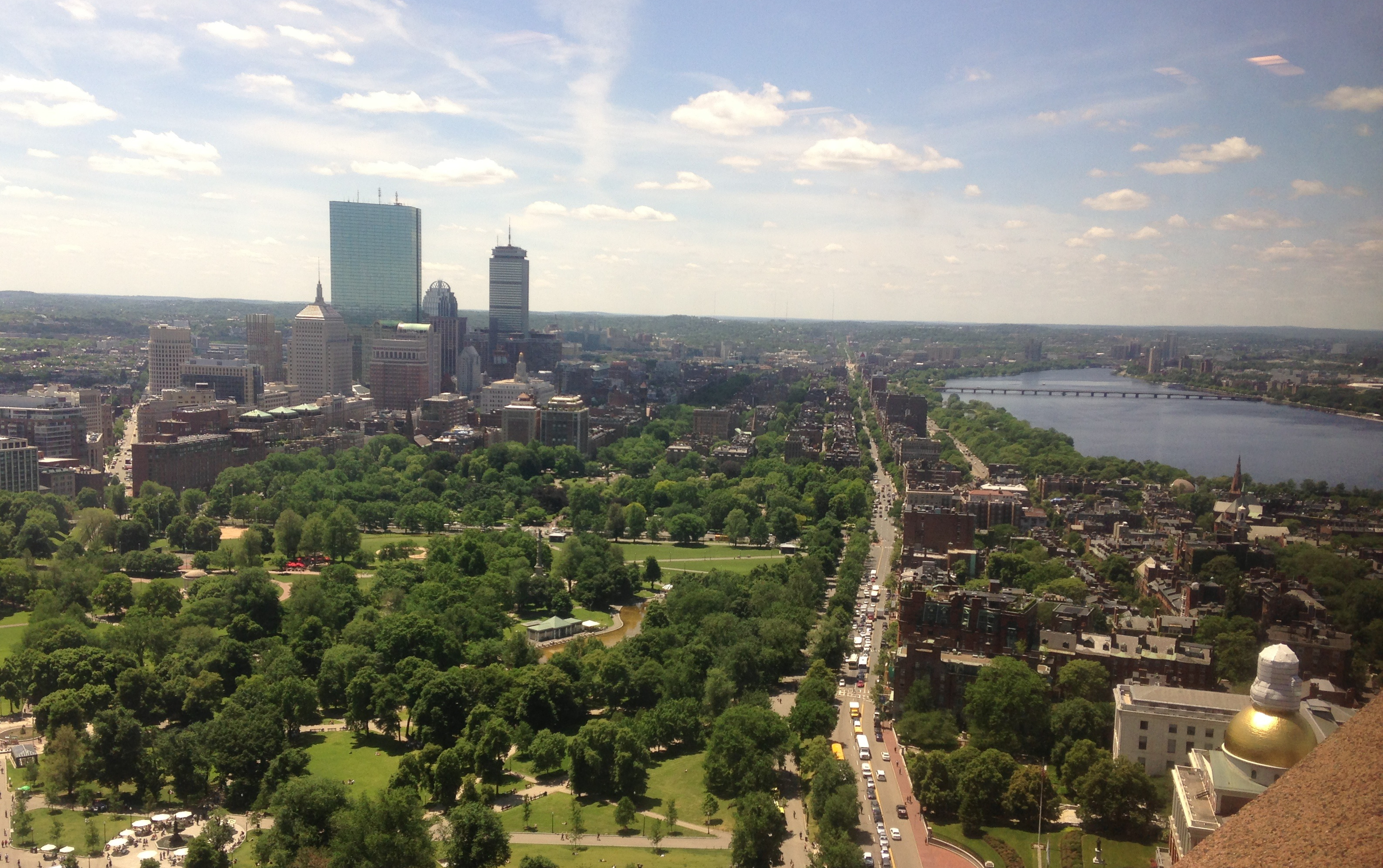
Boston skyline

In fiscally challenging times, states can achieve more when their agencies work together toward common goals. Massachusetts is doing exactly that.

Yesterday at the Multi-Family Housing Summit in Boston, three members of Governor Deval Patrick’s Cabinet announced their common vision for growth in Massachusetts. The vision highlights the housing, transportation, and environment agencies’ strong commitment to plan ahead for future growth and the Commonwealth’s Sustainable Development Principles. The goals are to:

  • Build 10,000 multi-family homes a year through 2020, particularly near transit, city/town centers and employment centers;
  • Shift the way we travel, by tripling the share of travel by bicycling, transit and walking; and
  • Reduce greenhouse gas emissions by 25% from the 1990 levels by 2020.

“We will achieve [the vision] only if we work together,” Transportation Secretary Richard A. Davey said during the Multi-Family Housing Summit where the announcement was made. Understanding the key connections between housing, economic development, transportation, environmental protection, and land use, Housing and Economic Development Secretary Greg Bialecki, whose agency hosted the Summit, said, “This [vision] is a pledge that we will think about each others agencies throughout our work.”

The 10,000 multi-family housing production goal was announced in November 2012 by Gov. Patrick as an outcome of the Governors’ Institute on Community Design workshop, which was held that summer.

In addition to the partnership, the Executive Office of Housing and Economic Development announced the formation of the Multi-Family Housing Advisory Committee to build broader support for multi-family housing and provide a structured forum for assessing and recommending new policies. The Advisory Committee will consist of 28 members, representing municipal and regional officials, members of the business and development community and non-profit and advocacy organizations, and will be staffed by state and quasi-public agencies. The formation of the Committee was also a recommendation made by the Governors’ Institute.

Similar stakeholder groups attended yesterday’s Multi-Family Housing Summit to discuss tangible strategies in achieving the 10,000 multi-family housing production goal. Bill Fulton, Director of the Governors’ Institute, presented on the recommendations that GICD provided in 2012 and facilitated the discussion.

The Governors’ Institute’s technical assistance is made possible and guided by the HUD-DOT-EPA Partnership for Sustainable Communities. The Partnerships promotes better coordination between housing, transportation, and other infrastructure investments to create more prosperous and vibrant communities.

Massachusetts Governor Deval Patrick introduces new workforce housing initiatives, adopts GICD recommendations

In July 2012, the Governors’ Institute on Community Design met with Massachusetts Governor Deval Patrick and his Administration to identify policies and tools to meet the State’s housing needs. Last week, Governor Patrick announced an ambitious housing policy initiative that builds on those strategies.

Speaking before an audience of almost 1,000 people at a statewide housing and community development conference in Worcester, MA on November 13, 2012, Governor Patrick announced a new statewide housing production goal of 10,000 multifamily units in the Commonwealth each year, and a new policy initiative called “Compact Neighborhoods.”

“To meet the needs of our workforce we need more housing for moderate- and middle-income families,” Governor Patrick said at the event. “We need more multi-family homes, rental apartments, and starter homes and we need these homes near jobs, near transit, and near city and town centers.”

“By 2020 across the state, we should see 80,000 new multi-family units. We can do this. In fact, we have to do this.”
– Governor Deval Patrick

The goal to build 10,000 new multifamily units each year, a first-of-its-kind housing production goal, is ambitious. But Governor Patrick and his Administration are determined to achieve this goal. By producing more housing that is affordable to moderate- and middle-income households—or “workforce housing”—that is reasonably dense and located near transit stations, employment and downtown centers, the Patrick Administration’s efforts will help build and retain a young and innovative workforce within the Commonwealth and strengthen the State’s economic competitiveness.

In addition to the housing production goal, Governor Patrick announced a new policy initiative called the Compact Neighborhoods program. The program provides additional incentives that encourage municipalities to identify as-of-right zoning districts (Compact Neighborhoods) and develop affordable and reasonably dense housing for working families near transit and town centers. Municipalities with Compact Neighborhoods can receive priority consideration for other state discretionary funding, including the MassWorks Infrastructure Program. Other funding programs will be considered this year to include a similar preference. The Compact Neighborhoods program complements Chapter 40R, the Commonwealth’s Smart Growth Overlay District Statute, by promoting neighborhoods with affordable housing choices near jobs and transit.

Both the housing production goal and the Compact Neighborhood program were among recommendations made by the Governors’ Institute to the Patrick Administration in a report last month, and support Governor Patrick’s comprehensive economic development plan. The Governors’ Institute has been working with the Patrick-Murray Administration on workforce housing policy since last spring. Workforce housing is a major issue in maintaining the Commonwealth’s economic competitiveness. Even though Massachusetts is the epicenter of the nation’s higher education system—350,000 students attend college or graduate school in the Boston area alone—the Commonwealth is often unable to retain this skilled young talent because of a shortage of affordable homes and lack of housing choices.

In July, the Governors’ Institute convened a high-level workshop that included Governor Patrick, Lieutenant Governor Tim Murray, several cabinet members, agency directors, and key stakeholders, such as local officials, business leaders, and housing organizations, as well as the Governors’ Institute’s nationally renowned housing, transportation, and real estate experts, to discuss policy ideas on workforce housing. Subsequently, the Governors’ Institute provided a set of recommendations to guide the Administration in strengthening its housing initiatives.

The Governors’ Institute’s technical assistance is made possible and guided by the HUD-DOT-EPA Partnership for Sustainable Communities. The Partnerships promotes better coordination between housing, transportation, and other infrastructure investments to create more prosperous and vibrant communities. The Patrick Administration’s new initiatives are a great example of policies and initiatives that the Partnership encourages across the country.

GICD Official Kick-off Event in the News

Governors Get on Board With Smart Growth

Streetsblog — August 2, 2012
The Governors’ Institute on Community Design isn’t a brand new undertaking — it’s been around since 2005 — but it’s just gotten some high-profile support which could catapult it to a different level. Yesterday, a bipartisan group of six governors and ex-governors celebrated the new support of the Partnership for Sustainable Communities – the collaboration of HUD, DOT, and EPA — for the Governors’ Institute. This kind of collaborative work, among federal agencies and with the states, is “common sense writ large,” said U.S. DOT Deputy Secretary John Porcari at the event.


Perdue to next governor: you have to make tough decisions

The News & Observer (NC) — August 1, 2012
Perdue was in Washington, D.C., on Tuesday with a long list of governors and former governors to discuss the infrastructure challenges facing state leaders during tough economic times. The event was organized by the Governors’ Institute, which provides technical guidance to governors on, among other needs, housing, transportation and the environment. “If you’re going to get things done and focus on the future and continue to invest in the future, you have to make tough decisions, and you can’t stick your finger in the wind and decide which way the public is going,” said Perdue.


Livability Funding for Governors’ Institute on Community Design will improve transportation options across America

Fast Lane (Official U.S. DOT blog) — August 1, 2012
At DOT, we are constantly looking for innovative partnerships to help solve our transportation challenges. Through our work in the Partnership for Sustainable Communities with the Department of Housing and Urban Development and the Environmental Protection Agency, for instance, we’ve helped communities boost economic development at the local level by thinking comprehensively about transportation, housing, and environmental needs. Good community planning requires a unified and collaborative approach. That’s why DOT is proud to join HUD and EPA in supporting the Governors’ Institute on Community Design in a new effort to help states grow their economies and make better use of taxpayer dollars.